
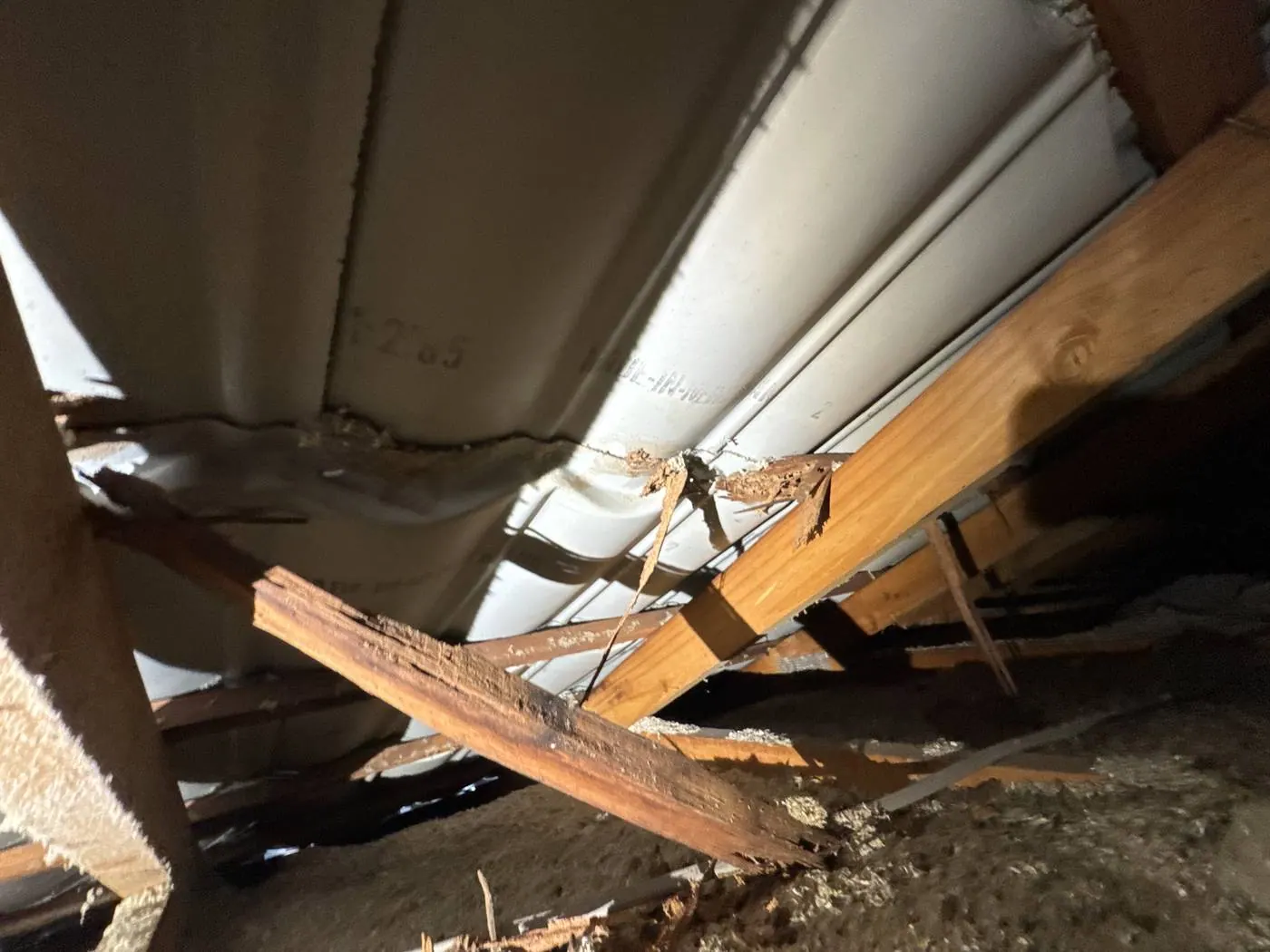
Across 68 of our own recent building and pest inspections, we confirmed termite activity or damage at 16 properties. Fourteen of the sixteen were standalone houses, mostly established ones. And where we could trace it, the story usually started in the yard, not in the house.
That's the most useful thing to know about termites on the Gold Coast: by the time there's anything to see inside, they've usually been outside for a long while.
Forget the sawdust
Most people picture termite damage as holes and piles of sawdust. Subterranean termites — the pest that matters in South-East Queensland — don't work that way. They eat timber from the inside out and leave the surface intact: a thin skin of paint over a hollowed-out middle. A skirting board can look freshly painted and be mostly gone.
What actually gives them away:
- Shelter tubes (mud tubes) — pencil-width tracks of soil running up piers, stumps, footings or fence posts. Termites build them to travel without drying out. This is the classic outdoor sign, and the one most worth learning.
- A hollow, dull sound when you tap timber that should knock solid.
- Spongy, springy floors — or floors slightly out of level underfoot.
- Doors and windows that have started sticking for no obvious reason.
- Blistered or rippled paint. Looks exactly like a water leak. Sometimes it is one — and moisture attracts termites, so either answer earns a closer look.
- Papery discarded wings on a windowsill or in a light fitting after rain. A swarm has happened nearby.
None of these is a diagnosis. Each one is a reason to look harder.
The yard falls first
Here's the pattern in three of those 16 properties. A 45-year-old two-storey house: the colony was established in a tree stump in the yard, with damage tracking into a structural beam and the floor system. A 28-year-old house: mudding and workings through the rear boundary fence. An 18-year-old house: confirmed damage, same story. Stump, fence line, garden timber — the foothold is almost always outside, well before the house itself.
Which is why, when we inspect, we often start where buyers least expect: walking the yard. Bush-backed suburbs with heavier vegetation and creek frontage — Gilston is a good example — carry this yard-level pressure most consistently. For what to check around the outside of a property yourself, see termite season on the Gold Coast.
How we find what's hiding
Since the damage hides under an intact surface, eyes alone aren't enough. Sounding — tapping skirtings, architraves and door jambs and listening for that dull, dead response — is a standard part of a timber pest inspection, backed by thermal imaging and an electronic moisture detecting meter where they earn their keep.
Let's be straight about the limits, because they matter to you as a buyer: no inspector can see inside a sealed wall cavity or under an inaccessible slab, whatever their marketing says. What a licensed inspector can do is read everything the accessible areas are saying — the tubes, the sounds, the moisture, the conducive conditions — and put it in writing. That written finding, in accordance with AS 4349.3, is what your solicitor and your negotiation actually run on.
What an "all clear" really tells you
A clear pest report means no activity or damage was observed in the readily accessible areas on the day — which is genuinely good news. But the more valuable half of the report is often the conducive conditions: garden beds built up against external walls, timber in ground contact, stored timber under the house, excessive moisture. No termites yet — but a written map of exactly what would invite them. Fix those and you've changed the odds; that's the report working for you long after settlement.
The report also draws a hard line between active termite activity and old termite damage — they're different findings with different next steps, and neither is a reason to panic. Our FAQs unpack both.
If we find it
The report records exactly what was observed and where, and points you to the right next step: a suitably licensed timber pest technician for further assessment — and where structural timber like a bearer, joist or beam is involved, a structural engineer. We deliberately don't guess at repair costs; that's the licensed trade's job to quote properly. What you get from us is the specific written finding for that property — so your negotiation, budget or walk-away decision starts from facts, not a feeling formed at an open home.
A timber pest inspection in accordance with AS 4349.3 is included in every combined building and pest inspection. Call 0431 114 815 — fixed price confirmed before you book.
CYTE carries out building and pest inspections across the Gold Coast and Northern NSW, with a written report delivered the same day.