
Inspection technology
Thermal Imaging in Building & Pest Inspections
Thermal imaging is a non-invasive aid that helps an inspector see what the eye alone cannot — temperature differences across a surface that can point to moisture, missing insulation or heat sources. CYTE inspections are supported by a FLIR E54 advanced thermal imaging camera, used to guide a closer look where it matters. It supports the visual inspection to AS 4349.1 and AS 4349.3; it does not replace it, and every finding is recorded in your same-day written report.
★★★★★5.0 from 75+ Google reviews
What it does
Seeing the Temperature, Not Through the Wall.
A thermal (infrared) camera measures the surface temperature of whatever it is aimed at and turns it into an image, where warmer and cooler areas show up as different colours. It does not see through walls or floors — instead, it reveals subtle temperature patterns on the surface that often signal something underneath. A cool, damp-looking patch on a ceiling can indicate water from a leaking roof or pipe; a uniformly cooler section of wall can indicate missing or settled insulation; a warm spot can indicate an issue worth looking at more closely.
None of these are conclusions on their own. Thermal imaging narrows down where to look, and those areas are then assessed more closely — frequently with a moisture meter — before anything is written up. Used this way, it adds a layer of information to a thorough visual inspection rather than standing in for one.
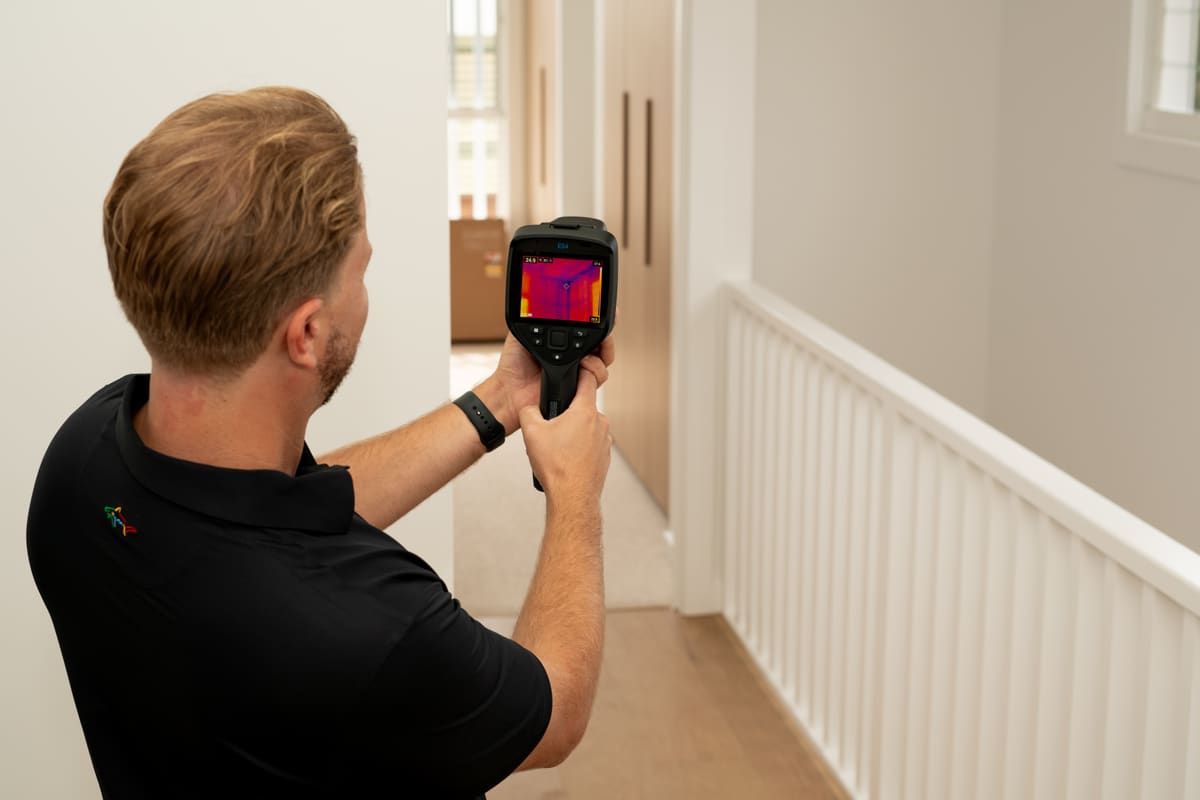
The camera
FLIR E54 — The Specifics.
The FLIR E54 is a professional-grade thermal imaging camera built for building inspection work. Its resolution and sensitivity are what make subtle moisture and insulation patterns readable, rather than guesswork.
| Specification | What it means on site |
|---|---|
| Detector resolution | 320 × 240 pixels — 76,800 individual temperature points in every image |
| Thermal sensitivity | Less than 40 mK (NETD) — surface differences as small as 0.04°C are visible |
| Temperature range | −20°C to 650°C, accurate to within ±2°C or ±2% of the reading |
| Field of view | 24° × 18° lens, capturing 30 thermal images per second |
| Visual detail | 5-megapixel camera with built-in LED and FLIR MSX, which overlays visible-light detail onto the thermal image |
| Display & reporting | 4-inch touchscreen, with Wi-Fi and Bluetooth for transferring images into the report |
How CYTE uses it
A Guide to a Closer Look.
During an inspection, the camera is used to scan ceilings, walls, wet areas and other surfaces where moisture and insulation problems tend to hide. Where an anomaly shows up, it is investigated further and, if relevant, confirmed with a moisture reading before it goes into your report. This is especially useful in units and apartments, where a leak from above or from an adjoining bathroom can show on a ceiling or wall long before it is visible to the eye.
Thermal imaging is one part of a complete building and pest inspection. It is an aid — the inspection itself remains a visual, non-invasive assessment to Australian Standards, and the written report is the deliverable you act on.
Common questions
Thermal Imaging, Answered.
Does a CYTE building and pest inspection include thermal imaging?
Where it helps, yes. A FLIR E54 thermal imaging camera is one of the professional tools brought to the job. Thermal imaging is an aid that points to areas worth a closer look — it supports, and does not replace, the visual, non-invasive inspection carried out to AS 4349.1 and AS 4349.3. Anything of note is recorded in your same-day written report.
Can a thermal camera see through walls?
No. A thermal camera does not see through surfaces — it reads the surface temperature of whatever it is pointed at. What it reveals is temperature differences across that surface: a cool patch on a ceiling can suggest moisture behind it, and a warm trail can suggest a heat source. Those anomalies are then checked further before anything is concluded.
Can thermal imaging detect termites?
Not on its own. Thermal imaging can highlight the temperature anomalies and moisture that sometimes accompany termite activity, which is a useful guide on where to look harder. Confirming timber pest activity is done through the timber pest inspection to AS 4349.3 — not by the camera alone.
How is thermal imaging used alongside a moisture meter?
They work together. The thermal camera shows where a surface is unusually cool or warm; a Tramex moisture meter then measures the actual moisture level in that material. Reading both together helps establish whether a thermal anomaly is moisture-related.
More in our FAQs, or read about the moisture meter we use.