
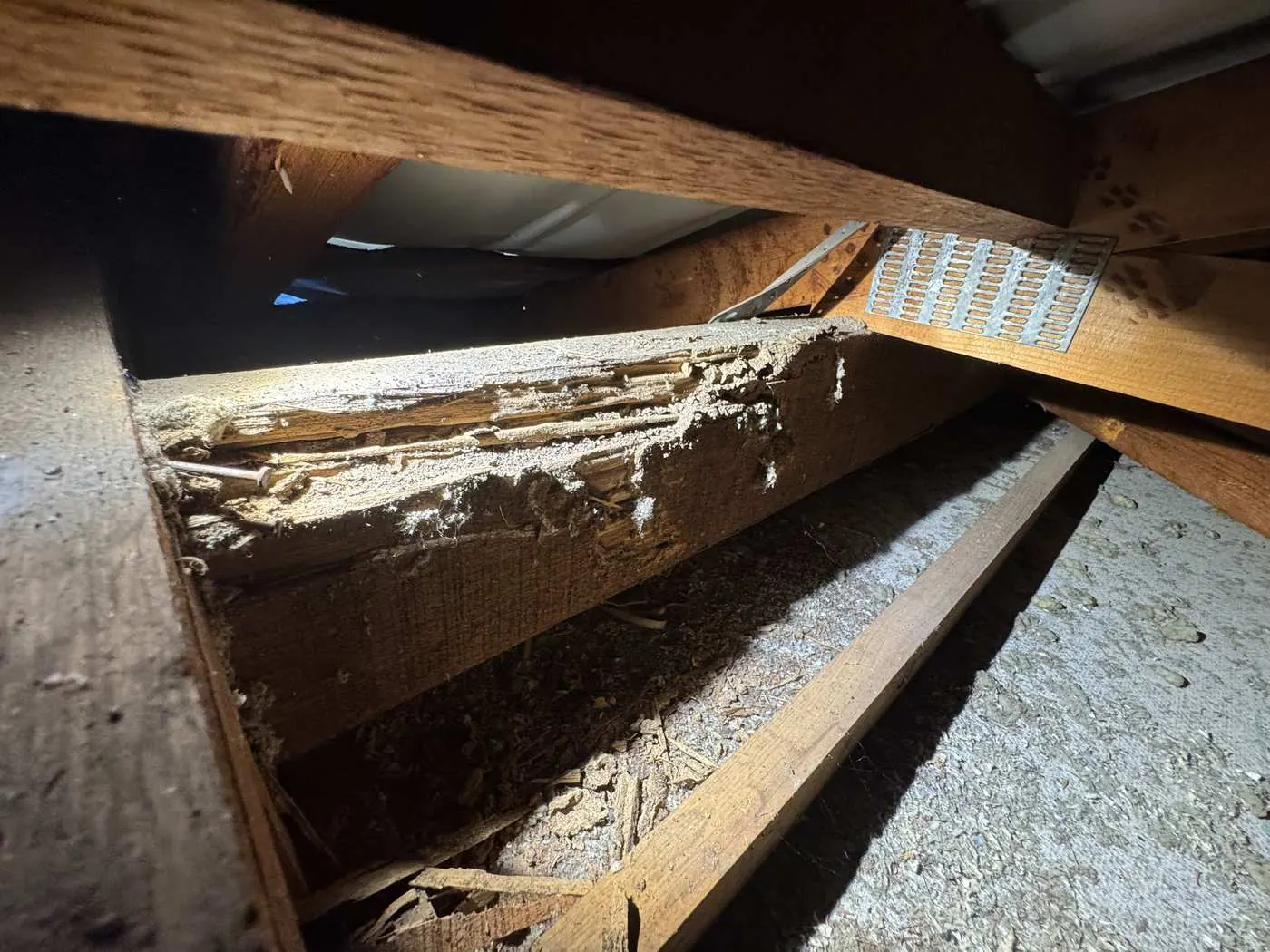
The building inspection gets the attention, but in South-East Queensland the timber pest inspection is often where the highest-stakes findings live. Termite damage is generally not covered by home insurance — which makes the inspection in accordance with AS 4349.3 a critical part of your due diligence.
What AS 4349.3 covers
A timber pest inspection is a visual, non-invasive assessment of the reasonably accessible areas for evidence of three things:
- Subterranean termites — active termites, workings, damage or evidence of previous treatment
- Wood borers — evidence of borer activity in structural and decorative timbers
- Fungal decay — timber decay associated with persistent moisture
Just as importantly, it identifies conducive conditions: the moisture sources, timber-to-soil contact, stored timber, garden beds against walls and poor ventilation that make a property attractive to timber pests in the first place.
Why a yearly inspection matters
A timber pest inspection reports the evidence that is observable at the time of inspection across the reasonably accessible areas — active workings, damage and the conducive conditions that invite them. Because termites can travel concealed inside walls or below ground, a fresh inspection at least once a year is strongly recommended in our climate, so you stay ahead of activity rather than relying on a single snapshot at purchase. Across 68 of CYTE's own inspections, confirmed termite activity or damage turned up in 16 properties — about 24%, and 14 of those 16 were standalone houses, mostly established ones — a reminder that a clear result today is a snapshot, not a guarantee, which is exactly why the annual check matters most on established homes.
Every CYTE combined inspection includes the timber pest assessment, with findings in the same written, photo-rich report, delivered the same day.
For practical prevention steps, see our article on five ways to reduce termite risk, and for unit and apartment buyers, our guide to why ground-floor units face higher termite risk. Read more in our FAQs.
What do conducive conditions actually look like on a Gold Coast property?
Most of our timber pest inspections do not find termites. They find conducive conditions, usually moisture-related. Three turn up again and again:
- Moisture reaching concealed framing. In units, perished shower silicone and grout, leaking shower screens and slow-draining showers that overflow the water stop are our most frequent finding: the defect shows in the bathroom; the damp timber is behind the wall. A damp, poorly ventilated subfloor does the same job. Elevated moisture is recorded as a condition conducive to structural damage and timber pest infestation, and further investigation by a suitably licensed and insured Plumber or Waterproofer, and a Timber Pest Inspector where relevant, is recommended.
- Missing ant capping on the steel posts under a deck or patio. An ant cap does not stop termites on its own; it forces them to build a visible mud tube around its edge, so activity can be seen. Without one, the deck framing can be reached unseen. Where deck framing shows damage or movement, further assessment by a Structural Engineer is recommended, and the deck should not be heavily loaded until then.
- No visible durable notice. On many properties, nothing visible on site confirms that a termite management system exists. The report records that; the question goes to the vendor or agent for a house, or the body corporate for a unit.
Which properties had termites in our inspections?
Mostly established standalone houses, and the first activity was usually in the yard rather than the house. Three of the 16 confirmed cases in our sample of 68 inspections show the pattern: a 45-year-old two-storey home with active termites in a tree stump and damage to a structural beam and the floor system, a 28-year-old house with active workings and mudding in the rear boundary fence, and an 18-year-old house with termite damage. Where termite damage reaches structural timber such as a beam or floor system, further assessment by a Structural Engineer is recommended. The two cases that were not standalone houses were a unit and a townhouse, so strata property is far less affected in our experience, but not immune. The other 52 properties had no termite activity or damage confirmed, though conducive conditions were recorded on nearly all of them.
A timber pest inspection in accordance with AS 4349.3 takes in the readily accessible areas of the grounds as well as the building, and this pattern is why that part of the inspection earns its time. Fence lines, stumps, retaining walls and garden timber are inspected because, in our inspections, that is where the first activity has usually been found, before anything shows in the house. For the seasonal side of that pattern, see when termite risk peaks on the Gold Coast.
Why is a clear timber pest result only a snapshot?
Because the report describes what was observable in the readily accessible areas on the day, and both the access and the conditions change afterwards. Anything that could not be reached, such as stored items in a garage, insulation over ceiling timbers or a roof space without safe and reasonable access, is recorded as not inspected rather than assumed clear. Many apartments are concrete roof and floor construction with no roof space at all, so the structure above the ceiling cannot be seen. The report says so, and that limit is taken into account when it assesses the risk of any activity going undetected. A good report is honest about those limits.
Then the property keeps changing. Shower silicone perishes, garden beds or mulch build up against the slab edge, a fence line ages and a stump stays where it was. None of that is visible in last year's report. Our guide to wet-area and shower defects in Gold Coast units shows how the first of those plays out. An annual building and pest inspection is how the picture is kept current, and it earns its keep most where fencing, garden timber or old stumps sit close to the walls.
Every CYTE combined building and pest inspection includes the AS 4349.3 timber pest assessment. Call 0431 114 815 to book.
CYTE carries out building and pest inspections across the Gold Coast and Northern NSW, with a written report delivered the same day.